
A therapist website is not a creative project. It is the front door to a private practice. A prospective client in the middle of a difficult month searches for a therapist at 11pm, opens five browser tabs, and decides within a minute which three they will actually call. What they find on the therapist's website, or what they fail to find, is what determines whether the call gets made.
The gap between what therapists need and what generic website builders offer is unusually wide. Most comparison posts treat therapy websites like any other small business site. They are not. A therapist website has specific demands: a calm, professional tone that does not feel like a marketing funnel, a clear path to an initial call, credentials and specialties that search engines can parse, and an appropriately cautious posture around any form that might accidentally collect protected health information. That last one is the piece most comparison posts get wrong.
This is an honest comparison of the website builders therapists actually use in 2026. It covers the general-purpose options (Squarespace, Wix, Carrd), the therapist-specialized platforms, the AI-first newcomers, and the question that comes up in every therapy practice forum: is Psychology Today enough by itself? Below, each option is evaluated on price, setup time, SEO readiness, and HIPAA considerations for a practicing clinician.
Research from Stanford's Web Credibility Project found that 75% of people judge a company's credibility based on its website design. For therapists, whose entire value proposition rests on trust, the first impression is formed before the first word of the initial call.
Quick Answer: NiftySite is the fastest path to a professional therapy website in 2026. AI generates the bio, specialties, and CTA copy from 3 onboarding questions. Live in about 10 minutes at $15/month with monthly billing. The therapist website builder is HIPAA-aware by design: no PHI collection, contact and booking go through the clinician's existing HIPAA-compliant tools. For a multi-page practice site with a blog, Squarespace remains the best general-purpose option. For a deeply customized therapy-industry workflow (intake forms integrated with an EHR), the therapist-specialized platforms are worth a closer look.
Transparency Note: This comparison is published on NiftySite's website. While we believe NiftySite is an excellent solution and have positioned it as our top choice, we've conducted thorough research on all tools listed here to help you make an informed decision based on your specific needs. We've included objective data (pricing, setup time, features) and highlighted areas where other tools may be better suited for specific use cases. Compliance guidance in this article is general; every practice should confirm HIPAA specifics with their own compliance advisor.
What Therapists Actually Need From a Website
The criteria for a therapist website are different from the criteria for a coffee shop, a SaaS landing page, or a portfolio site. Before any tool evaluation, a therapist should know what they are actually looking for.
- A calm, credible presence. Prospective clients are not scrolling for entertainment. They want to see a real clinician, real credentials, and a clear sense of whether this therapist is a good fit for them.
- Fast setup. Most therapists do not want to spend five evenings in a builder. The right tool is the one that gets a professional page live in one sitting.
- HIPAA-aware posture. A public-facing website does not need to be HIPAA-compliant in the EHR sense, but it should not collect PHI through contact forms. Intake should always be routed through a HIPAA-compliant system.
- SEO readiness. Most therapy practice inquiries start with a search like "anxiety therapist in [city]" or "trauma therapist that takes my insurance." The site needs to be indexable and structured so search engines can understand it.
- A clear call to action. One primary next step: a booking link, a contact prompt, or a consultation request. Not five.
- Mobile-friendly. Therapy inquiries disproportionately happen late at night on phones. A site that breaks on mobile is a site that loses clients.
Most therapists evaluating builders start with Squarespace because a colleague used it, then realize halfway through the third evening that they have been decorating a page instead of launching a practice. The tool choice should remove that friction, not add to it.
Best Website Builders for Therapists, Quick Verdict
| Tool | Best For | Starting Price | Setup Time | HIPAA-Aware |
|---|---|---|---|---|
| NiftySite | Solo therapist who needs a professional page fast | Free / $15/mo Pro | 10 minutes | Yes (no PHI collection) |
| Squarespace | Multi-page practice site with a blog | $7/mo (annual) | 2+ hours | Depends on setup |
| Wix | Maximum design control for a private practice site | $17/mo (annual) | 3+ hours | Depends on setup |
| Carrd | Ultra-simple one-page presence on a tight budget | $9/year | 30-60 min | Depends on setup |
| Specialized therapist platforms | EHR-integrated practice sites | Varies (typically $59-99/mo) | Days | Yes (with BAA) |
| Psychology Today (directory) | Insurance-directory exposure | $29.95/month | 30 min | N/A (directory, not a site) |
1. NiftySite, Best for Solo Therapists Who Need a Page Fast
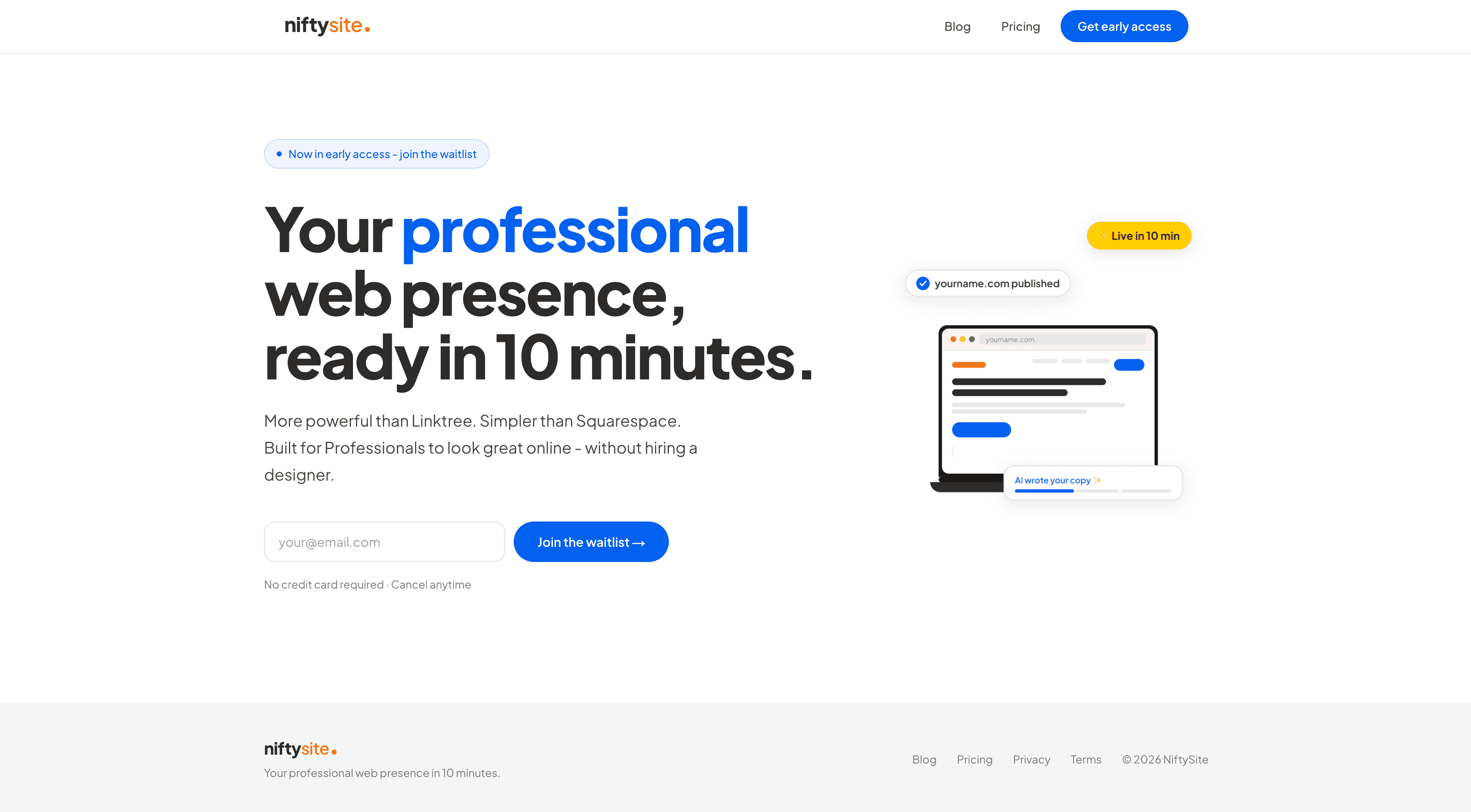
NiftySite is a niche website builder for people who charge for their time: therapists, coaches, consultants, personal trainers. A therapist answers three questions about their specialties, their ideal client, and the shape of their practice. The AI generates a calm, professional headline, bio, and CTA copy. The therapist reviews and tweaks. The page is live within the same session.
The design philosophy is the opposite of a general-purpose builder. Instead of a blank canvas with 200 design decisions, the therapist template is pre-structured around how therapists introduce themselves: name and credentials, specialties, therapeutic approach, and a contact prompt. The visitor finds what they need in under 10 seconds. The clinician finishes in about 10 minutes.
Why NiftySite is #1 for Solo Therapists
Live in 10 minutes, not 10 evenings. Most therapists who try Squarespace or Wix abandon their site somewhere between "choosing the right font" and "why is this footer stuck." NiftySite removes both the copywriting block and the design block at the same time.
AI copy that matches how therapists actually speak. The AI is not a generic marketing bot. It has been prompted around the tone therapists use, careful, specific, uncluttered. The output is a bio that reads like a clinician wrote it, not like a sales page. Every line is editable.
HIPAA-aware by design. The therapist website builder does not collect or store PHI. Contact forms collect only what a public-facing site should, a name, an email, a note, and forward to the therapist's email. Intake, assessment, and any real client data stay in the therapist's HIPAA-compliant intake system (SimplePractice, TherapyNotes, Alma, Headway, etc). The website's job is to signal credibility and hand off the inquiry. That is it. Always confirm specifics with your own compliance advisor.
Built-in SEO. Clean metadata, fast load times, structured data, and a sensible URL structure are handled by default. Therapists on NiftySite have a real shot at ranking for "anxiety therapist in [city]" or their name plus specialty, the two searches that actually drive new client inquiries.
Monthly billing. NiftySite charges $15/month with no annual option by design. Therapists can start, publish, and cancel without a 12-month commitment. There is also a free plan.
A professional starting URL. The subdomain yourname.niftysite.co is clean, professional, and works immediately. For therapists who already own a practice domain, custom domain support is on the near-term roadmap.
Key Features
- AI-generated bio, specialties summary, and CTA from 3 onboarding questions
- Therapist-aware template with sections for credentials, approach, specialties, and fees
- Inline text editing, click any section to customize
- Contact form with email notification (no PHI collection)
- Links section for external booking systems (Calendly, SimplePractice, TherapyNotes portal)
- Built-in analytics: page views and link clicks
- Mobile-responsive by default
- Clean subdomain at
yourname.niftysite.co
Pricing
| Plan | Price | Notes |
|---|---|---|
| Free | $0 | Public page, NiftySite subdomain |
| Pro | $15/month | Full editing, AI copy, analytics |
- Monthly billing only, cancel anytime
- Free plan requires no credit card
- Single flat-rate Pro plan, no feature tiering
Pros
- Fastest setup of any option on this list, genuinely about 10 minutes
- AI copy removes the blank-page problem
- Therapist-specific template, not a repurposed small business layout
- Monthly billing, no annual lock-in
- HIPAA-aware public presence by design
- Free plan with no credit card required
Cons
- Single-page only, not the right choice for a multi-page practice site with a blog
- Custom domain currently on the roadmap, not yet available
- Not a full practice management platform, does not replace an EHR or intake system
Best For
Solo therapists, counselors, and psychotherapists who need a credible professional page for their practice website and want to be live today rather than three weekends from now. Also a strong fit for group practices that want a quick public-facing page while their main practice management system handles everything else.
2. Squarespace, Best for a Multi-Page Practice Site With a Blog
Squarespace is the most polished general-purpose website builder on the market. For therapists who want a multi-page practice site with a blog, a resources library, and room to grow into group practice branding, it is a capable option, and currently the most common choice in the category.
The trade-off is time. A first-time therapist using Squarespace typically spends one to two weekends building a site they are willing to publish. The templates are beautiful but blank on the copy side: every word on the site is something the therapist writes from scratch. Setup realistically runs 2+ hours for a single page and 8-15+ hours for a complete multi-page practice site. The full Squarespace review for coaches applies almost entirely to therapists as well, the time and copywriting investments are the same.
Key Features
- Best-in-class template quality, genuinely polished output
- Full multi-page site with native blog, portfolio, and commerce
- Appointment scheduling (extra cost) and email marketing integrations
- 14-day trial (site goes dark after trial ends without subscribing)
- Rated 4.4/5 on G2 (1000+ reviews) and 4.6/5 on Capterra (2900+ reviews)
Pricing
| Plan | Annual | Monthly |
|---|---|---|
| Basic | $7/mo | $9/mo |
| Core | $8/mo | $12/mo |
| Advanced | $12/mo | $17/mo |
No free plan. See the full Squarespace pricing breakdown for the hidden-cost details.
Pros
- Polished, professional design out of the box
- Multi-page capability with native blog
- Large ecosystem and strong SEO defaults
- Reliable uptime and security
Cons
- Setup is measured in weekends, not minutes
- No AI copy help, the therapist writes every word
- 14-day trial only, no free plan
- Annual billing required for the cheapest advertised rate
- Contact forms are not HIPAA-compliant by default; PHI should not be collected through them without additional safeguards
Best For
Therapists who want a full practice website with multiple pages, plan to publish a blog regularly, and have the time (and the patience) to invest in a proper build. A great fit for group practices with a dedicated admin to own the site.
3. Wix, Most Design Flexibility, Most Decisions
Wix is the most flexible general-purpose website builder available. 900+ templates, drag-and-drop everywhere, every section customizable. A therapist with design instincts and a weekend to spare can build almost anything. For a therapist who just wants a professional page, Wix is usually overkill.
The issue with Wix for a therapy practice is the same issue with Wix for any solo professional: the flexibility comes at the cost of time. There is no niche-specific template for therapists. There is no AI copywriting (Wix ADI helps with layout, not language). Every design decision is still a decision the therapist has to make.
Key Features
- 900+ templates across all categories
- Wix ADI generates a basic layout from onboarding questions
- Full e-commerce, booking, and integration support
- 4.2/5 on G2 (1600+ reviews) and 4.4/5 on Capterra (10,000+ reviews)
Pricing
| Plan | Annual | Monthly |
|---|---|---|
| Light | $17/mo | $23/mo |
| Core | $29/mo | $38/mo |
| Business | $39/mo | $55/mo |
Free plan exists but shows Wix ads and uses a wixsite.com subdomain, not suitable for a professional practice.
Pros
- Maximum flexibility of any builder in this comparison
- Strong feature breadth (booking, e-commerce, blog)
- Good mobile editor
- Large ecosystem of apps
Cons
- Overwhelming for a therapist who just wants a simple page
- No niche-specific therapist template
- No AI copy generation
- Free plan shows ads, unusable for a real practice
- Setup realistically runs 3+ hours for a first-time builder
Best For
Therapists who enjoy design, want a multi-page site with e-commerce or booking built in, and have time to invest. Not recommended for therapists whose main goal is "be live by Friday with a credible page."
4. Carrd, Cheapest One-Page Option
Carrd is the cheapest real website builder on this list. $19/year for the Pro Standard tier includes custom domain support and basic analytics. For a therapist who wants a bare-bones one-page presence and is comfortable writing their own copy from scratch, Carrd delivers at a price point nothing else matches.
The honest version of Carrd: it is a blank canvas with good bones. No AI. No niche template for therapists. No built-in structure for credentials, specialties, or a therapist-appropriate bio. The therapist writes every word and makes every layout choice. Setup runs 30-60 minutes if the therapist knows what they want to say.
Key Features
- Drag-and-drop builder, clean output
- Contact form, embed, and third-party integrations
- Pro Standard adds custom domain + basic analytics
- Annual billing only (no monthly option)
Pricing
| Plan | Price | Custom Domain | Analytics |
|---|---|---|---|
| Free | $0 | No | No |
| Pro Lite | $9/year | No | No |
| Pro Standard | $19/year | Yes | Basic |
| Pro Plus | $49/year | Yes | Advanced |
Pros
- By far the cheapest paid option
- Pages load fast and look clean
- Decent for a minimal single-page presence
- Simple, predictable, no upsells
Cons
- Blank canvas, the therapist writes all their own copy
- No therapist-specific template or onboarding
- Annual billing only
- No AI, no niche structure, no guided setup
- Analytics locked behind the $19/year tier
Best For
Budget-conscious solo therapists who are comfortable writing their own copy, want a minimal page, and do not need AI assistance or niche-specific design. Closer to a landing page than a practice website.
5. Therapist-Specialized Platforms (Brighter Vision, TherapySites, SimplePractice Website Builder)
A small number of platforms are built specifically for therapy practices. The most commonly discussed are Brighter Vision, TherapySites, and the website builder included with SimplePractice. These sit in a different category than the general-purpose builders above: they are bundled with practice management features, designed with therapy in mind from the first pixel, and typically come with BAAs (Business Associate Agreements) available for clinical use.
The trade-offs are also different. Specialized therapist platforms typically cost more than a general-purpose builder, the common range is roughly $59 to $99+ per month, and often charge for design services on top of the monthly fee. Setup is usually handled by the vendor's design team over days or weeks, not minutes. That is great for therapists who want a fully done-for-you site and are willing to pay for it. It is the wrong fit for therapists who want to be live today on a solo-practice budget.
Specific feature sets and pricing change frequently, always verify directly with the vendor. At a high level:
- Brighter Vision: done-for-you therapy websites with SEO and marketing services bundled. Typically mid-range monthly pricing with additional design and support fees. Full-service, highest hand-holding.
- TherapySites: template-based therapy sites with built-in scheduling and forms. Generally lower monthly fee than Brighter Vision, still therapist-specific.
- SimplePractice Website Builder: included with some SimplePractice plans. Limited customization but tightly integrated with the SimplePractice EHR, a strong choice if the therapist is already on SimplePractice.
Best For
Therapists who want a fully done-for-you site with practice management features and direct EHR integration, and who have the budget for $59-99+/month of tool cost plus design fees. Less appropriate for solo practitioners on a tight budget who just need a professional front door.
6. Psychology Today (A Directory, Not a Website Builder)
Psychology Today deserves a specific note because so many therapists ask whether it replaces a website. It does not. Psychology Today is a therapist directory, the therapist rents a profile on a platform owned by someone else, at approximately $29.95 per month. The profile appears in Psychology Today searches and can drive real client inquiries, especially in competitive cities.
A Psychology Today profile is valuable. It is also a rental. It does not rank for the therapist's own name or practice brand on Google, because Psychology Today's domain outranks any profile page. The therapist cannot control the layout, the copy beyond certain fields, or the calls to action. And if Psychology Today's search algorithm or pricing changes, every therapist relying on it is affected at the same time.
The therapist landing page at NiftySite covers this distinction directly: Psychology Today and a real website are not alternatives to each other. They work together. A therapist should have both. The directory provides discovery. The owned website provides credibility, SEO for the therapist's own name, and a place where the therapist controls the narrative.
Feature Comparison: All Options
| Feature | NiftySite | Squarespace | Wix | Carrd | Specialized platforms | Psychology Today |
|---|---|---|---|---|---|---|
| AI copy generation | Yes | No | Partial (layout only) | No | Varies | N/A |
| Therapist-specific template | Yes | No | No | No | Yes | N/A (directory) |
| Setup time | ~10 min | 2+ hours | 3+ hours | 30-60 min | Days/weeks | ~30 min |
| Monthly billing | Yes | Optional (+) | Optional (+) | No (annual only) | Usually | Yes |
| Free plan | Yes | No | Yes (with ads) | Yes (limited) | No | No |
| HIPAA-aware by default | Yes (no PHI) | Depends on setup | Depends on setup | Depends on setup | Yes (with BAA) | N/A |
| Multi-page | No | Yes | Yes | No | Yes | N/A |
| Custom domain | Coming soon | Yes | Yes | Pro Standard+ | Yes | N/A |
| Owned by the therapist | Yes | Yes | Yes | Yes | Yes | No (rented profile) |
HIPAA and Therapist Websites, The Short Version
HIPAA is the single most confused topic in therapist website advice. The practical rules, in plain language:
- A public-facing marketing website does not itself need to be HIPAA-compliant if it is not collecting, storing, or transmitting protected health information.
- The risk is in the contact form. If a potential client types detailed symptoms, medication history, or insurance ID into a website contact form, that form has now touched PHI. A contact form that collects a name, an email, and "what would you like to discuss" is generally considered low-risk, though best practice is to explicitly tell visitors not to share detailed clinical information in the form.
- Intake belongs in a HIPAA-compliant intake system. SimplePractice, TherapyNotes, Headway, Alma, and similar platforms are built for this. The public website should hand off to one of these, not try to replicate it.
- A BAA (Business Associate Agreement) is only required for a tool that actually handles PHI. A website builder that never touches PHI (because the practice routes intake through a separate HIPAA-compliant system) does not require a BAA with the website host.
NiftySite's therapist-aware design is built around exactly this distinction. The public site collects what a business card collects, a name and an email, plus a short note. Everything clinical routes through the therapist's real intake system. For therapists who want clinical intake embedded directly on the website, one of the specialized platforms above is the better fit, but those systems also require a BAA and specific clinical workflows, which is a much bigger investment.
As always: this is general guidance, not legal advice. Every private practice should confirm its specific compliance approach with a HIPAA-qualified advisor.
Which Should You Choose?
Choose NiftySite if you:
- Are a solo therapist, counselor, or psychotherapist
- Need a credible, professional page live this week (not this summer)
- Want AI to write the first draft of your bio and specialties summary
- Prefer monthly billing with no annual commitment
- Route clinical intake through a separate HIPAA-compliant system (SimplePractice, TherapyNotes, Headway, Alma)
Choose Squarespace if you:
- Want a full multi-page practice site with a native blog
- Plan to publish regularly and treat the website as a long-term asset
- Have 10+ hours to invest in setup and copywriting
- Are on a group practice team where someone owns the site full-time
Choose Wix if you:
- Want the most design flexibility available
- Enjoy the design process and want fine-grained control
- Are comfortable making a lot of decisions before the site is done
Choose Carrd if you:
- Want the absolute cheapest option
- Are comfortable writing every word of your own copy
- Need a minimal single-page presence, not a full practice site
Choose a specialized therapist platform if you:
- Want a fully done-for-you site built by a therapy-focused team
- Need tight EHR integration (particularly if you are on SimplePractice)
- Have the budget for $59-99+/month plus potential design fees
- Want a BAA on the website host itself
Use Psychology Today in addition to, not instead of, a real website. Both have jobs a therapist practice benefits from.
Frequently Asked Questions
What is the best therapy website builder?
The best therapy website builder depends on whether you want speed or full customization. For a solo clinician who needs a credible page live quickly, NiftySite is the strongest therapist website builder in 2026: it writes your bio, specialties, and call-to-action from three questions, launches in about 10 minutes at $15/month, and stays HIPAA-aware by never collecting PHI on the public page. For a multi-page practice site with a blog, Squarespace is the best general-purpose builder for therapists. For a done-for-you site with EHR-integrated intake, a specialized therapist platform fits better.
What is the best website builder for therapists in 2026?
For most solo therapists, NiftySite is the best fit. It generates therapist-appropriate copy from three onboarding questions, launches in about 10 minutes, costs $15/month with monthly billing, and keeps the public site HIPAA-aware by not collecting PHI. For therapists who want a full multi-page practice site with a blog, Squarespace is the best general-purpose option. For therapists who want a fully done-for-you site with EHR integration, the specialized therapist platforms are worth exploring.
Do therapists need a HIPAA-compliant website builder?
Usually no, as long as the public-facing website does not collect, store, or transmit protected health information. Most therapy practices keep their marketing site and their clinical intake system separate. The marketing site collects only low-risk contact info (name, email, short note). The clinical intake happens inside a HIPAA-compliant system like SimplePractice, TherapyNotes, Headway, or Alma. If a therapist wants to embed clinical intake directly on their website, a specialized therapist platform with a BAA is the right choice.
Is Psychology Today enough, or do I need my own website?
Psychology Today is valuable for discovery, but it is not a substitute for a therapist's own website. The directory profile cannot rank for the therapist's own name on Google, cannot be fully customized, and is entirely controlled by a third party. A real website lets the therapist rank for their own name, specialties, and city. Most established private practices use both: Psychology Today for directory visibility, an owned website for credibility and SEO.
How much does a therapist website cost?
The practical range for solo therapists is $0 to $99+/month. NiftySite is free to start, $15/month for Pro with monthly billing and no annual commitment. Carrd costs $9-49/year with annual billing only. Squarespace runs $7-17/month on annual billing. Wix is $17-55/month on annual billing. Specialized therapist platforms like Brighter Vision typically fall in the $59-99+/month range and may add design service fees. Domain registration adds roughly $10-20/year on most tools; on NiftySite a subdomain is included.
How long does it take to build a therapist website?
On an AI-first tool like NiftySite, about 10 minutes from start to published. Carrd takes 30-60 minutes with copy prepared. Squarespace or Wix typically require 2-5+ hours minimum for a single page and 10-20+ hours for a complete practice site. Specialized therapist platforms usually take days or weeks because setup is handled by the vendor's design team.
What should a therapist website include?
Credentials and licensure. Specialties, approach, and the kinds of clients the therapist works with. A professional photo. Fees or a clear policy around fees. A concise contact prompt that routes serious intake into a HIPAA-compliant system. An honest statement on availability. The therapist website builder at NiftySite structures every one of these sections into the default template so a therapist does not have to invent them.
Does a therapist website help with SEO?
Yes, significantly, if the site is built with search in mind. A therapist website optimized for the therapist's name, specialties, and city can rank for exactly the searches that drive real client inquiries ("EMDR therapist in Boston," "anxiety therapist in Austin"). A Psychology Today profile cannot do this, because the Psychology Today domain outranks the profile page. NiftySite generates clean metadata, structured data, and fast-loading pages by default, which gives a solo therapist a real shot at ranking locally.
Can I use Squarespace for a therapy practice?
Yes, Squarespace is a capable choice for a therapy practice website, particularly if the practice wants a multi-page site with a blog. The main caveats: the default contact forms are not HIPAA-compliant, so PHI should not be collected through them without additional safeguards, and setup realistically takes 10+ hours for a complete practice site. The NiftySite vs Squarespace comparison covers the time-and-cost trade-off in detail, the same math applies to therapists.
What is the difference between a website builder and a therapist directory?
A website builder produces a site that the therapist owns, a domain the therapist controls, copy the therapist writes, SEO the therapist captures. A therapist directory (Psychology Today, Zencare, Open Path Collective) is a paid profile on a platform owned by someone else. The directory drives discovery to the directory's own search. A real website drives discovery to the therapist's own domain. Established practices typically use both.
Do group practices need a different solution than solo therapists?
Often yes. A solo therapist is usually best served by a one-page professional presence, exactly what NiftySite is built for. A group practice with multiple clinicians, specialties, insurance panels, and a blog typically needs a multi-page site, which means Squarespace, Wix, or a specialized therapist platform is the better fit. Some group practices use NiftySite for each clinician's individual bio page plus a separate site for the practice itself.
Can I move my site later if I outgrow my starter builder?
Yes. A therapist who starts on NiftySite and later needs a multi-page practice site can move to Squarespace or a specialized platform. A therapist who starts on Squarespace can move away too, though the migration involves rebuilding pages. The practical advice: do not let fear of outgrowing a tool delay the decision by six months. A credible page published today is always better than a perfect page that never launches.
What is the biggest mistake therapists make with their website?
Waiting until it is perfect. Therapists, who are wired to get things right for their clients, often apply the same standard to their own marketing. The result is a site that has been 80 percent done for ten months. Published beats polished every single time. A simple, honest, credible therapist page that has been live for six months is infinitely more valuable than a perfect site that is still in a draft folder.
Conclusion
For most solo therapists, the right answer in 2026 is not Squarespace, not Wix, and not a specialized platform with a five-figure annual commitment. It is a tool that takes the therapist from "I need a website" to "here is my website" in one sitting, at a price that does not require the practice to be fully established first, with an HIPAA-aware posture baked in from the start.
That is what NiftySite was built for. Three questions, ten minutes, a professional therapist page at $15/month with no annual commitment. For a multi-page practice site with a blog, Squarespace remains a strong choice with a much longer setup runway. For a fully done-for-you therapy site with EHR integration, a specialized therapist platform is the right fit at a higher price point.
The practical move for most solo practitioners: get something credible published this week. Iterate from there. The clients looking for a therapist tonight will find what is actually online, not what is still in a Google Doc.
Running a private practice? We go deeper on the essentials in websites for therapists in private practice.
Last updated: April 2026. All pricing and features verified as of publication date. Compliance guidance is general, not legal advice.

A therapist website that respects your time and your clients
Three questions, ten minutes, and a calm, professional therapy page that is ready for the inquiries you get this week. HIPAA-aware by design. Free to start.
Build your therapist pageReady in 10 minutes. Pro at $15/mo. No annual lock-in.