
Short answer: If you are running courses, memberships, or active email marketing to a paid audience, yes. If you primarily run 1:1 coaching and just need a professional web presence, no. Kajabi is a full creator business platform at $143 to $179 a month. For coaches who need the website portion and nothing else, that is roughly 10 times what a focused website builder costs.
Most coaches who ask "do I need Kajabi" are asking the wrong question. The real question is "what am I actually going to use?" Kajabi is genuinely excellent at what it does. It is also a platform where most coaches who sign up end up using one feature (the website) and paying for seven others (courses, community, email, pipelines, affiliates, memberships, coaching products) that sit idle.
According to the International Coaching Federation's 2023 Global Coaching Study, there are 109,200 coach practitioners worldwide, with 71% working independently. That means most coaches are solo operators deciding how to spend their tool budget. Overspending on a platform built for scale is a common early mistake.
This guide covers:
- What Kajabi actually charges you for, feature by feature
- The profiles of coaches who genuinely need it and the ones who do not
- What to use instead if a website is all you really want
- How to decide based on the stage of your business, not the Instagram coaches you follow
By the end, a reader will know if they actually need Kajabi, what the cheaper alternatives look like if they do not, and how to pick a tool that matches the stage of their coaching practice rather than the stage they hope to reach someday.
What Kajabi Is and Why Coaches Keep Hearing About It
Kajabi is an all-in-one platform for knowledge creators. It launched in 2010 and became the default choice for coaches selling online courses, memberships, and digital products. The pitch is real: one platform instead of five or six separate tools. Courses, community, email marketing, funnels, a website, and checkout all live in one admin panel and talk to each other without a Zapier connection.
For a coaching business with real digital products at scale, that consolidation is genuinely valuable. The problem is that most coaches who pay for Kajabi are not running that kind of business yet.
Why so many coaches end up on Kajabi
The answer is mostly social, not technical. A few reinforcing forces push coaches toward the platform:
- Every high-profile coach on Instagram seems to use it. If the coaches you follow run Kajabi, it starts to feel like the serious choice.
- The marketing positions it as all-in-one. That framing makes it feel like the forward-looking pick, since you might launch a course eventually.
- Coaching programs recommend it. Many certifications and masterminds use Kajabi internally and recommend it to students.
- FOMO on future features. "What if I launch a course next year and I am on the wrong platform?" is a real anxiety.
None of these are bad reasons on their own. They are just not evidence that Kajabi fits the stage of the business making the decision.
What Kajabi actually includes
Here is what the platform gives you on the Basic plan, which is the tier most coaches actually use:
- Course hosting with modules, drip scheduling, quizzes, and a dedicated student portal
- Membership platform with recurring billing and gated content
- Built-in community space (like Circle or Skool)
- Full email marketing with sequences, automations, behavioral triggers, and segmentation
- Pipeline builder for multi-step sales funnels
- Website and page builder
- Coaching products with session scheduling
- Payments via Stripe and PayPal
- Mobile app for students
That is 9 product features on one plan. If you are actively using 6 of them, the consolidation saves money compared to stitching together Teachable, ConvertKit, Circle, and a website builder. If you are using 1 of them, you are paying retail for 9 and getting value from 1.
The Kajabi review covers the feature depth in full detail. For this guide, the relevant point is simpler: Kajabi is priced for the combined stack, not the individual pieces.
Why This Matters If You Are Just Starting Out
A coaching business goes through distinct stages, and the tools that fit each stage change. Paying for the stage you hope to reach is one of the most common and expensive early mistakes.
According to the Grand View Research 2023 report on the life coaching market, the global life coaching market is worth $4.56 billion and growing at 6.7% a year. That growth is driven by new coaches entering the market, most of whom spend their first 12 to 24 months building a client base through 1:1 work before they have anything to sell as a course.
What happens when a new coach signs up for Kajabi at $143 a month on annual billing:
- They pay $1,716 a year upfront
- They use the website builder to build a basic professional page
- They intend to set up email, launch a course, and build a community "soon"
- Six months in, they have not launched, and they have paid $858 for a platform they are using at 15% capacity
- They cancel at month 10, having paid $1,430 for a website
That is a real pattern, and it comes up consistently in the Kajabi alternatives for coaches discussion. Kajabi's marketing does not cause it. The mismatch between tool and stage does.
What a coach actually needs at each stage
A practical way to think about it:
- Stage 1 (Year 0 to 1): Professional web presence. People can find you, understand what you do, and get in touch. That is it.
- Stage 2 (Year 1 to 2): First digital product launch. A signature course, group program, or paid community. Now you need course delivery, payment processing, and some email automation.
- Stage 3 (Year 2+): Multiple products, active email marketing, possibly a membership. Now the tool sprawl becomes the problem, and Kajabi's all-in-one consolidation starts to pay off.
Kajabi is designed for Stage 3. A coach at Stage 1 using Kajabi is paying Stage 3 prices for a Stage 1 outcome. The website is the only thing they actually need, and a focused website builder does that job for $15 a month or less.
The Options: Kajabi Versus a Focused Website Builder
If a coach just needs a website, the real choice is between a full creator platform (Kajabi) and a focused website builder (things like NiftySite, Squarespace, or Carrd). The feature gap between these two categories is large. The cost gap is larger.
Kajabi pricing in 2026
Here is what Kajabi actually costs across its four tiers, verified against kajabi.com:
| Plan | Monthly billing | Annual billing | Annual total |
|---|---|---|---|
| Basic | $179/mo | $143/mo | $1,716/year |
| Growth | $249/mo | $199/mo | $2,388/year |
| Pro | $499/mo | $399/mo | $4,788/year |
Annual billing is effectively required for reasonable pricing. Most coaches end up on Basic at $143 a month on annual billing, which comes to $1,716 a year.
Focused website builders
Three categories of focused builder that coaches actually consider:
| Tool | Starting price | Setup time | AI copy | Best for |
|---|---|---|---|---|
| NiftySite | Free / $15/mo Pro | 10 minutes | Yes | Coaches who want the copy written for them |
| Squarespace | $7/mo (annual) | 1 to 2+ hours | No | Coaches who want a multi-page design-led site |
| Carrd | $9 to $49/year | 30 to 60 minutes | No | Coaches with copy already ready |
The annual cost gap between a focused builder and Kajabi Basic ranges from $1,500 to $1,700 a year. That is not a small difference for a coach at the stage where every dollar is ideally going into client acquisition.
When Kajabi is the right call anyway
Honest trade-offs matter. Kajabi is genuinely the right choice in specific situations:
- A signature course with multiple modules and active students
- A paid membership community with recurring revenue
- An email list over 1,000 contacts that drives consistent product sales
- Pipelines and funnels running for webinars or launches
- Combined course and membership revenue above roughly $2,000 a month
For those coaches, the all-in-one consolidation is real value. The NiftySite vs Kajabi comparison covers where each tool genuinely wins.
How to Decide: Do You Need Kajabi or Just a Website?
A simple decision framework, not a sales pitch. Work through these in order.
Step 1: Write down what you actually use your tools for
Not what you plan to use them for. What you use today. Count the active features: email sequences going out, courses with students enrolled, memberships with paying members, funnels running a launch sequence.
A common pattern for coaches at Stage 1: one item on that list. A website. That is the whole answer.
Step 2: Audit what Kajabi costs versus what a website-only tool costs
If the answer to Step 1 is "website and maybe occasional emails to 200 people," here is the cost comparison:
| Scenario | Annual cost | Annual cost saved versus Kajabi Basic |
|---|---|---|
| Kajabi Basic (annual billing) | $1,716 | Baseline |
| NiftySite Pro at $15/mo | $180 | $1,536 |
| Squarespace Basic at $7/mo (annual) | $84 | $1,632 |
| Carrd Pro Standard | $19/year | $1,697 |
At Stage 1, the $1,500+ annual difference is not abstract. That is roughly three to five months of runway, or a Facebook ads budget for an entire quarter, or a coaching certification program.
Step 3: Ask if the missing features are actually blocking you
The Kajabi features a website builder does not replace are course hosting, community, full email marketing, and pipeline building. For each one, ask honestly:
- Is this feature actually blocking revenue today?
- Would having it unblock something I am planning to launch this quarter?
- If not, is there a free or cheap alternative I can use for now?
Free or cheap interim options:
- Course hosting: Teachable Starter at $29 a month (annual) or Thinkific's free plan for 1 course
- Community: Free Discord or Circle at $49 a month when it becomes necessary
- Email marketing: ConvertKit free tier up to 1,000 subscribers, or Mailchimp free tier
- Funnels: A single landing page, not a full pipeline, for early launches
Combining a website builder plus two of these at Stage 1 or 2 often costs $40 to $80 a month, which is still meaningfully less than Kajabi and lets you pay for tools as you use them.
Step 4: Pick your website builder based on what is stopping you
This is where the choice gets practical. Most coaches stall at one of three blockers:
- The blank canvas. You do not know what to write on your page. Pick a builder with AI copy generation, like NiftySite, which asks 3 questions and generates your headline, bio, and CTA automatically.
- Multi-page site requirements. You need a blog, services page, about page, and portfolio. Pick Squarespace or similar.
- Budget is the only constraint. You can write your own copy and just need cheap hosting. Pick Carrd at $19 a year.
For coaches specifically, the blank canvas is the most common blocker. That is why NiftySite exists as a coaching website builder: the AI writes the hard part, the template is built for coaching businesses, and the free forever plan lets you publish before paying anything.
Step 5: Set a calendar check-in for 90 days out
Whatever you pick, set a reminder to evaluate in 90 days. If by then you have:
- Launched a course with active students, or
- Built an email list of 1,000+ that drives product sales, or
- Started a paid membership
Then it is time to reconsider Kajabi. Until then, you have picked the tool that matches the stage you are actually at.
Tools Coaches Actually Use for a Website
A practical rundown of the main options with honest trade-offs.
#1NiftySite
Your professional web presence in 10 minutes
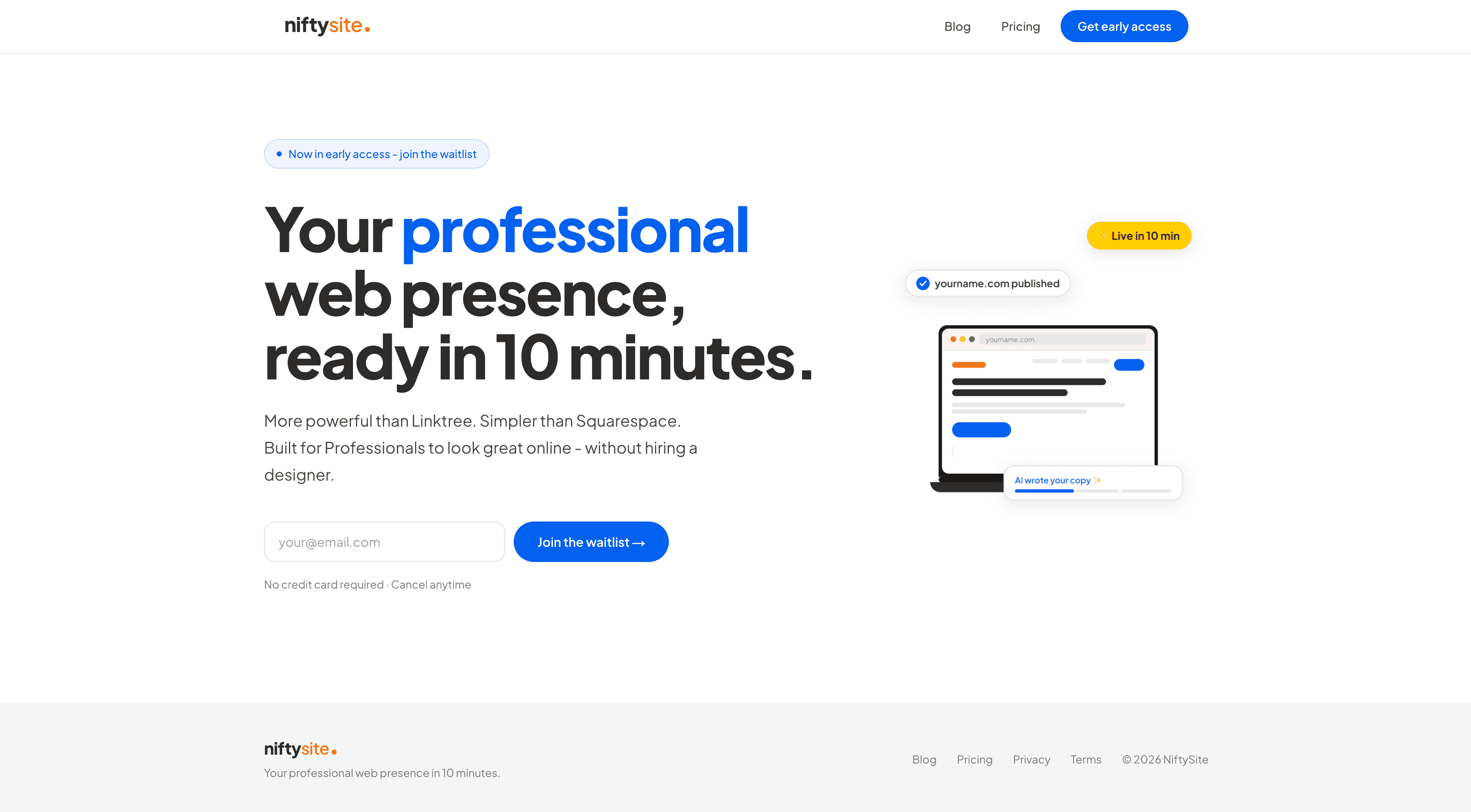
NiftySite is a niche website builder for coaches, consultants, therapists, personal trainers, and tradespeople. The core mechanic is AI copy from 3 questions: what you do, who you help, and what changes for your clients. The AI generates your headline, bio, and CTA automatically. Free users get prefilled copy from the onboarding answers. Pro users get polished AI copy and unlimited regeneration. The coaching website builder page covers the full positioning. Best for coaches who have been putting off their website because the copywriting step is the blocker.
Squarespace
Design-led multi-page website builder
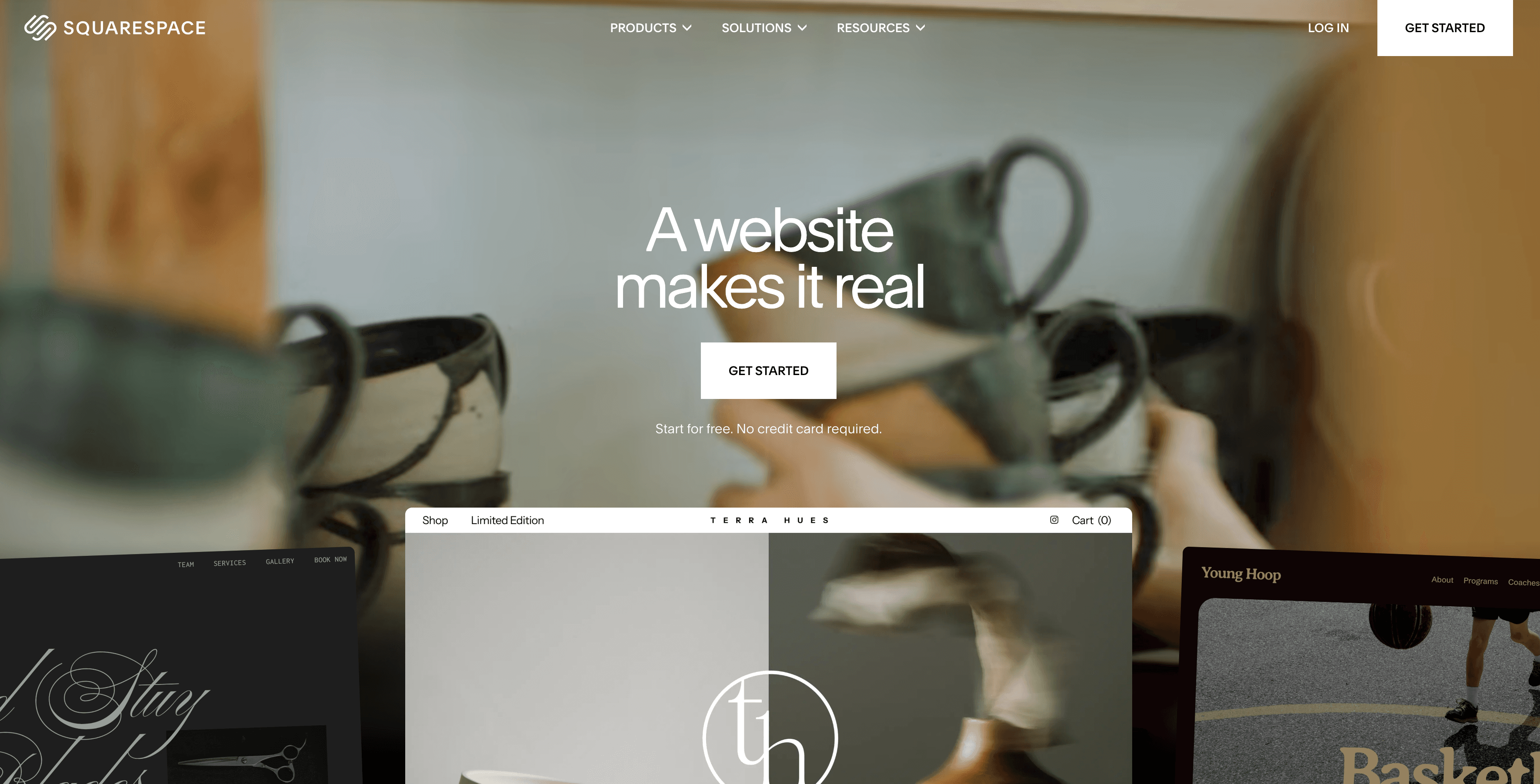
Squarespace is the premium general-purpose website builder. The templates are polished, the typography is strong, and the output can look as good as a custom-designed site. The trade-off is time: 1 to 2+ hours for a basic setup, no AI copy generation, and all content written from scratch. The 14-day trial takes your site offline when it ends. Best for coaches who specifically want a multi-page site with blog and services pages and are willing to invest the build time.
Carrd
Cheapest hosted one-page builder on the market
Carrd at $19/year for Pro Standard is genuinely the cheapest hosted site with a custom domain, contact form, and basic analytics. No AI copy, annual billing only, generic templates. Best for coaches who are confident writers and already know what their page should say. The Carrd review covers the detailed trade-offs, and the NiftySite vs Carrd comparison covers the head-to-head directly.
Feature comparison
A condensed view of the same decision:
| Feature | NiftySite | Squarespace | Carrd | Kajabi |
|---|---|---|---|---|
| AI copy generation | Yes | No | No | No |
| Coaching-specific templates | Yes | No | No | No |
| Setup time | 10 min | 1 to 2+ hours | 30 to 60 min | Weeks |
| Monthly billing | Yes | Optional | No, annual only | Optional, more expensive |
| Free plan | Free forever | 14-day trial | Yes (subdomain, branding) | 14-day trial |
| Annual cost | $180 | $84 | $19 | $1,716 |
| Course hosting | No | No | No | Yes |
| Email marketing | No | Campaigns add-on | No | Yes |
| Community | No | No | No | Yes |
For a coach at Stage 1 who just needs a website, the top three columns cover it. The last column is relevant only when the business has grown into the feature set.
Best Practices and Common Mistakes
Five things that matter and four mistakes that are worth avoiding.
Best practices
- Match tool spend to revenue. A working rule: your tool stack should be 5 to 10% of your monthly coaching revenue, not 50%. A coach earning $1,500 a month should not be paying $250 a month in tools.
- Start with the narrowest tool that solves the current problem. If you need a website, buy a website builder. Not a platform that also does courses and email marketing you are not running.
- Use free tiers to test fit before committing. NiftySite's free forever plan lets you publish before paying anything. Carrd has a free tier. Even Kajabi has a 14-day trial, though the site goes offline after.
- Write your bio before picking your tool. Most coaching websites stall on copywriting, not tool choice. If you already have your headline, bio, and services description written, any builder works. If you do not, pick a tool with AI copy generation, which solves the real blocker directly.
- Set a 90-day review. Whatever tool you pick, revisit the choice after 3 months based on what you actually used.
Common mistakes
- Buying Kajabi for a course you have not built. Wait until the course exists and has students. Paying for course infrastructure before the course is the most expensive form of optimism.
- Picking the cheapest option without evaluating the blocker. Carrd at $19 a year sounds perfect until you realize the blank canvas is the reason you have not launched your website in the first place.
- Assuming you will outgrow a simple tool. Maybe, eventually. Most coaches stay at Stage 1 for 12 to 24 months. Buying a Stage 3 tool on day one is overpaying for the future at the expense of the present.
- Copying what Instagram coaches use without checking the stage gap. The coach you follow with 50,000 Instagram followers runs a Stage 3 business. Their tool stack does not fit a Stage 1 business.
Frequently Asked Questions
Do I need Kajabi if I only do 1:1 coaching?
No. Kajabi's feature set is built around selling digital products at scale, not managing a 1:1 practice. For 1:1 coaching, you need a professional website, a scheduling tool like Calendly, and a payment method like Stripe. Kajabi's course, community, and email marketing features are unused in a pure 1:1 practice, and you pay for all of them regardless. A focused website builder plus Calendly and Stripe typically runs $20 to $30 a month combined.
Is Kajabi overkill for a new coach?
Almost always, yes. Kajabi's Basic plan is $143 a month on annual billing, which comes to $1,716 a year. New coaches typically spend their first 12 to 24 months building a client base through 1:1 work, and they do not have courses, memberships, or active email marketing yet. Paying for that infrastructure before you use it is the most common and expensive early mistake. A tool like NiftySite at $15 a month covers the website need, and you can add course or email tools when you actually need them.
Can I use Kajabi just for the website?
Technically yes, but it is expensive and awkward. The Kajabi website builder is consistently noted in reviews as feeling like a secondary feature, and you pay for everything else regardless. If a website is the only Kajabi feature you plan to use, you pay $143 to $179 a month for what a focused website builder does for $15 to $17 a month. The math rarely works in Kajabi's favor for website-only use.
What is the cheapest Kajabi alternative website only?
Carrd at $19 a year for Pro Standard is the absolute cheapest option. Its limitation is the blank canvas: no AI copy, no coaching-specific templates, and you write every word yourself. If writing your own copy is not a problem, Carrd is unbeatable on price. If the blank canvas is the reason you have been putting off your website, NiftySite at $15 a month generates your copy from 3 questions and gets you published in 10 minutes.
Does NiftySite replace Kajabi?
No, and it is not trying to. NiftySite is a website builder, not a course platform. It does not have course delivery, membership management, email marketing, or funnels. What it replaces is the website portion of Kajabi, which is what most coaches actually use Kajabi for. If you also need courses and email marketing, NiftySite does not cover that. If you just need a credible professional website, NiftySite does the job at roughly 10% of the cost.
Is Kajabi worth it for coaches running a course?
Usually yes, if the course is active and generating revenue. Kajabi's course delivery, student portal, drip scheduling, and quizzes are best-in-class. If you have a signature course with modules, enrolled students, and a sales process running, Kajabi's $143 a month pays for itself through better student retention and tool consolidation. If the course is planned but not launched, wait. Pay for it when the course exists.
How do I know if I am at the stage where Kajabi makes sense?
Three signals: (1) you have an active course, membership, or digital product generating at least $500 a month in revenue; (2) you send marketing emails at least twice a month to a list of 500+ engaged contacts; (3) you are currently paying for three or more of: Teachable or Thinkific, ConvertKit or ActiveCampaign, Circle or Skool, and a website builder. If all three are true, Kajabi's consolidation is a real cost saver. If none are, you are likely still at the website-only stage.
What should I use if I just want a coaching website fast?
NiftySite is the fastest path to a published professional coaching page. Answer 3 onboarding questions, the AI generates your headline and bio, pick a theme, and publish. Most users are live in 10 minutes on the free forever plan. Upgrade to Pro at $15 a month when you want the badge removed, Google indexing, analytics, contact form, and unlimited AI copy regeneration. The coaching website builder is specifically designed for the coach who just needs a credible presence now.
Do coaches need Kajabi to look professional?
No. Clients do not know or care what platform runs your website. They notice if your site loads quickly, clearly explains what you do, and makes it easy to contact you. A well-built $15 a month site looks more professional than a poorly-configured $149 a month Kajabi site. Tool choice is invisible to the end user. The only thing that matters is if your page earns the discovery call.
Is Kajabi or a website builder better for a coaching practice starting out?
A focused website builder is almost always the better fit for a starting practice. The kajabi vs website builder question comes down to feature usage: a website builder covers the one feature a new coach actually needs (a professional page), while Kajabi covers eight features a new coach probably is not using yet. Start with a website builder at $15 a month. Move to Kajabi when the business has grown into the larger feature set.
Can I switch from a website builder to Kajabi later if I need to?
Yes. There is no lock-in on either side. If you start with NiftySite or Squarespace and later decide to launch courses and memberships, you can rebuild your site on Kajabi or keep the website separate and add a course platform. The cost of switching is some setup time, not exported data or contract penalties. Starting simple does not trap you at simple.
Is Kajabi cheaper than multiple separate tools?
Sometimes, but only at scale. If you are paying for Teachable ($29/mo), ConvertKit ($29/mo), Circle ($49/mo), and a website builder ($15/mo), that stack comes to $122 a month combined. Kajabi Basic at $143 a month is close to that, and Growth at $199 a month is more. The consolidation argument works if you use all the features actively. If you use two of them, separate tools are cheaper.
Conclusion
The "do I need Kajabi" question almost always resolves to no once a coach honestly audits what they actually use. Kajabi is an excellent platform for coaches running courses, memberships, and active email marketing at scale. Outside of that use case, it is a platform a coach pays for but does not use.
Three key takeaways:
- Match tool spend to the stage of the business. Stage 1 coaches need a website. Stage 3 coaches need an all-in-one platform. Paying Stage 3 prices for a Stage 1 outcome is the most common and expensive early mistake.
- The $1,500 a year difference between Kajabi and a focused website builder is not abstract. At early stages, that money pays for client acquisition, certifications, or runway.
- Pick the builder that solves the actual blocker. The blank canvas, multi-page design requirements, and raw budget are three different problems. Different tools solve each one well.
If the reader is ready to get a professional coaching page live this week, NiftySite has a free forever plan, no credit card required. Answer 3 questions, see your AI-generated page, publish when ready, upgrade to Pro at $15 a month when you want the badge removed and full editing. For coaches who are ready for Kajabi, the Kajabi review and Kajabi alternatives for coaches guide cover the full picture. Pick based on what you actually use today, not the coach you hope to become someday. The tool will still be there when the business catches up.
Last updated: April 2026. All pricing verified against official sources.

Get your coaching website live in 10 minutes
Free forever plan, no credit card required. Upgrade to Pro at $15 a month when you want more.
Build your pageFree forever. Pro at $15/month, cancel anytime.