
A coaching business is one of the simplest businesses on paper. No product to ship, no inventory, no storefront. The whole business is: a coach, a defined problem they help solve, and a way for the right clients to find and pay them. When the pieces fit, the margins are excellent and the schedule is genuinely flexible.
When the pieces do not fit, it is also one of the easiest ways to spend a year working hard and earning almost nothing. Most new coaches do not stall because they lack skill. They stall because they treat the business like a hobby and hope referrals will fill the calendar on their own. The coaches who build sustainable practices bring the same care to the business that they bring to their clients: a clear niche, a priced offer, a credible online presence, and a steady source of new conversations.
This guide is the practical version of how to start a coaching business in 2026. No "find your purpose" detour. Below is what the work actually looks like, in the order it should happen, whether the plan is a side practice on evenings and weekends or a full-time leap out of corporate.
The opportunity is real and measurable. The International Coaching Federation's Global Coaching Study tracks more than 109,000 active coach practitioners worldwide, with 71% working independently rather than inside firms. The market keeps growing, but the bar for looking credible has risen with it. Coaches who win clients in 2026 are the ones who show up looking like a real practice from day one, starting with a professional web presence. The coaching website builder at NiftySite was built for exactly that step.
Here is what this guide covers:
- The honest state of the coaching market in 2026
- How to choose a niche that actually attracts paying clients
- The pricing models that work, and the one to pick first
- Legal, tax, and certification setup without overcomplicating it
- Building the professional online presence that converts referrals
- Landing the first paid client, the step most new coaches get wrong
- Delivery systems that protect the calendar and the energy
- Keeping the pipeline full once the first clients are in
- The mistakes new coaches make most often
- Answers to the questions new coaches ask most
The Coaching Market in 2026, Honestly
Demand for coaching is at an all-time high. The combination of remote and hybrid work, flatter org structures, and growing acceptance of mental fitness as a normal investment has pushed coaching from a luxury into a line item. Grand View Research values the US life coaching market at $1.98 billion in 2024, projected to reach $3.08 billion by 2033. Executive coaching, career coaching, and health coaching all sit on similar growth curves. Buyers, whether individuals paying out of pocket or companies paying for staff, are more comfortable than ever hiring an independent coach.
The flip side is competition. Every prospective client now has access to dozens of coaches via Instagram, TikTok, podcasts, and referrals. The ones who get hired are not always the most experienced. They are the ones who show up with crisp positioning, an obvious specialty, a priced package, and a website that confirms the first impression. Generic "I help people unlock their potential" framing gets scrolled past in under three seconds.
None of this is a reason to wait. It is a reason to plan the business properly before posting anything.
What "Starting a Coaching Business" Actually Means
There are two different things people call "starting a coaching business," and they need very different plans.
The first is a coaching practice: a one-person business where the coach delivers all the sessions, sets the offers, and owns the client relationships. This is what almost every new coach is actually building in their first two years. Revenue scales with hours booked and rates charged. Overhead is low.
The second is a coaching company: a multi-coach business with associates, a brand independent of the founder, and recurring corporate contracts. That is a real path, but not a starting point. It is something a successful practice grows into after three or four years.
This guide is about the first version. The mechanics of starting are simple: pick a niche, design an offer, handle legal and financial basics, build a credible presence, and run repeatable client acquisition. The discipline is doing those steps in order, instead of getting stuck on a logo for six weeks.
Step 1: Pick a Niche You Can Actually Defend
The single biggest lever in a new coaching business is niche selection. A clear niche makes pricing easier, marketing easier, referrals easier, and conversion easier. A vague niche makes every single one of those things harder.
A useful niche has three properties:
- A specific person. Not "professionals," but "newly promoted engineering managers." Not "women," but "women in their first year of postpartum return to work."
- A specific problem. Not "growth," but "stalled before staff engineer." Not "balance," but "constant low-grade burnout."
- A reachable place. LinkedIn groups, Slack communities, niche subreddits, professional associations, partner networks. If the only way to find them is luck, the niche is too thin.
Most new coaches resist niching because they fear cutting off clients. The reverse is true. A defined niche is the reason a referrer remembers a coach and the reason a stranger books a discovery call. Specialists charge more than generalists in every adjacent profession, and coaching is no different.
A clean test: write the one-line introduction first. "I help X solve Y so they can Z." If it sounds like five other coaches in the same week, the niche is too broad. If it sounds boring but specific, it is probably right.
A few niche directions that consistently generate demand in 2026: leadership coaching for first-time managers in tech, career coaching for women returning from parental leave, health coaching for people on GLP-1 medications, ADHD coaching for high-performing adults, and performance coaching for early-career founders. Those are examples of what specificity looks like, not the only options.
Step 2: Design an Offer and Set a Price
A coaching offer is not "hourly coaching." A coaching offer is a named outcome over a defined period for a clear price. New coaches who sell hours sell the cheapest version of their work. New coaches who sell outcomes sell the most valuable version.
Three offer structures cover almost every successful starting practice:
Package of sessions. A fixed number of sessions (often six or twelve) over a defined window (often three or six months) with one outcome named in the contract. Pay upfront or split into installments. Best for one-to-one career, executive, and life coaching.
Monthly retainer. A flat monthly fee for ongoing access, often weekly or biweekly sessions plus messaging support between calls. Best for performance coaching, accountability work, and embedded executive coaching.
Group program. A cohort that runs together for a defined window, with live group calls, optional one-to-one slots, and shared materials. Best for niches with a common problem and a willingness to learn alongside peers.
Pricing follows the offer. The Stanford Web Credibility Project found that 75% of users judge a company's credibility from its website design. The same dynamic shapes coaching prices: clients pay more when the entire package, from the offer name to the website to the welcome email, looks intentional. Underpricing in the first year is far more common than overpricing. A sustainable solo practice in most niches needs to land somewhere between $2,000 and $10,000 per engagement, not $97 per session.
A simple starting model: pick one offer (package, retainer, or group), name the outcome, write the inclusions, set the price, and ship that single offer for ninety days. Resist the urge to launch three offers at once. The constraint is a feature; it makes every decision after it faster.
For a deeper breakdown of pricing math, the coaching website cost breakdown and the related pricing strategies in the consulting world are useful references. Most pricing principles translate directly across professions.
Step 3: Handle the Legal, Tax, and Certification Basics
The legal setup for a solo coaching practice is not complicated. Skipping it is what creates problems, not getting it slightly wrong.
The basics that almost every solo coach in the US needs:
- A business entity. An LLC is the default, cheap to form (often under $200), separates personal and business liability, and signals professionalism. Single-member LLCs are taxed as sole proprietorships by default, which keeps filing simple.
- An EIN. Free from the IRS, ten minutes. Required for a business bank account and clean 1099 income.
- A separate business bank account. Non-negotiable. Mixing money is the fastest way to lose hours to bookkeeping later.
- A coaching agreement. A simple contract covering scope, payment, cancellation, confidentiality, and the fact that coaching is not therapy. ICF templates or a coaching attorney are inexpensive and sufficient.
- Liability insurance. Professional liability runs about $300 to $600 a year for solo coaches and is required by some corporate buyers.
- Sales tax. Coaching services are not taxable in most US states, but a quick check with the state revenue site is worth ten minutes.
Certification is a separate question. The ICF, NBHWC (for health coaches), and a handful of niche bodies offer credentials. None are legally required to call oneself a coach in most jurisdictions. They matter most when selling to corporate buyers or working in regulated niches. A new coach with a strong niche can start without a credential, then earn one in year one or two if the buyer base demands it.
Step 4: Build the Professional Presence Buyers Actually Check
Every potential client, every referral, every podcast guest pitch ends in the same behavior: a Google search of the coach's name. What that search returns either confirms the first impression or kills it. The BrightLocal Local Consumer Review Survey finds that 54% of consumers are most likely to visit a business's website after seeing a positive signal elsewhere. For coaches, the website is the moment of truth.
A coaching website does not need to be elaborate. A one-page site, done well, outperforms a five-page site full of placeholder content. The page needs to communicate, in this order:
- Who the coach helps and what outcome they deliver. One sentence above the fold.
- Credibility. Photo, brief bio, relevant credentials, named past clients or contexts when possible.
- The offer. Named package, included sessions, price (or "starts at"), and a clear next step.
- A way to book. Calendly, Cal.com, or a direct contact form. One click, not three.
- Social proof. One or two testimonials, ideally with the client's first name and a specific outcome.
Most new coaches put off building this for months because the available tools feel either too thin or too heavy. Linktree is too simple to look like a real practice. Squarespace and Wix are too heavy for a coach who does not have two weekends to spend on a website. This middle gap is where NiftySite was built. It produces a professional one-page coaching website in about ten minutes, with AI-generated copy from a short intake, a clean niche-aware template, and analytics that show who is visiting.
The choice of platform matters less than getting the site live. A live page that says exactly what the coach does is worth more than a perfect page that never publishes.
Tools That Actually Fit a Starting Coaching Practice
The realistic options for a new coach building a presence in 2026:
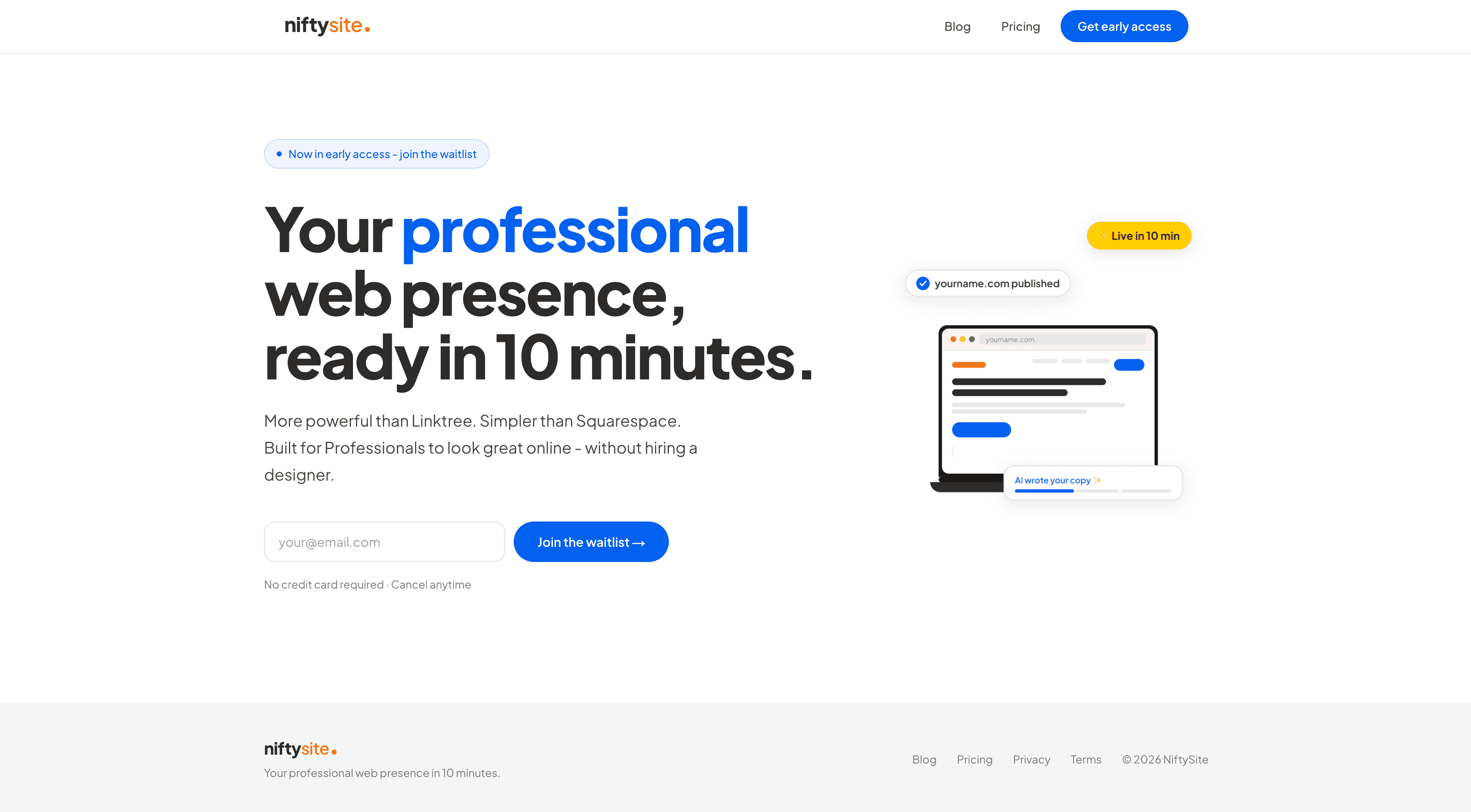
NiftySite is built specifically for solo professionals who charge for their time. The coaching template is niche-aware: the intake questions, the default sections, and the default copy all reflect a real coaching practice. AI generates the headline, bio, and CTA from short answers, so coaches who freeze at a blank page still finish. Pro is $15 a month with monthly billing and no annual lock-in, and there is a free forever tier that keeps a published page live without a credit card. For most new coaches, this is the right starting point.
#1NiftySite
Your professional coaching site in 10 minutes
Squarespace
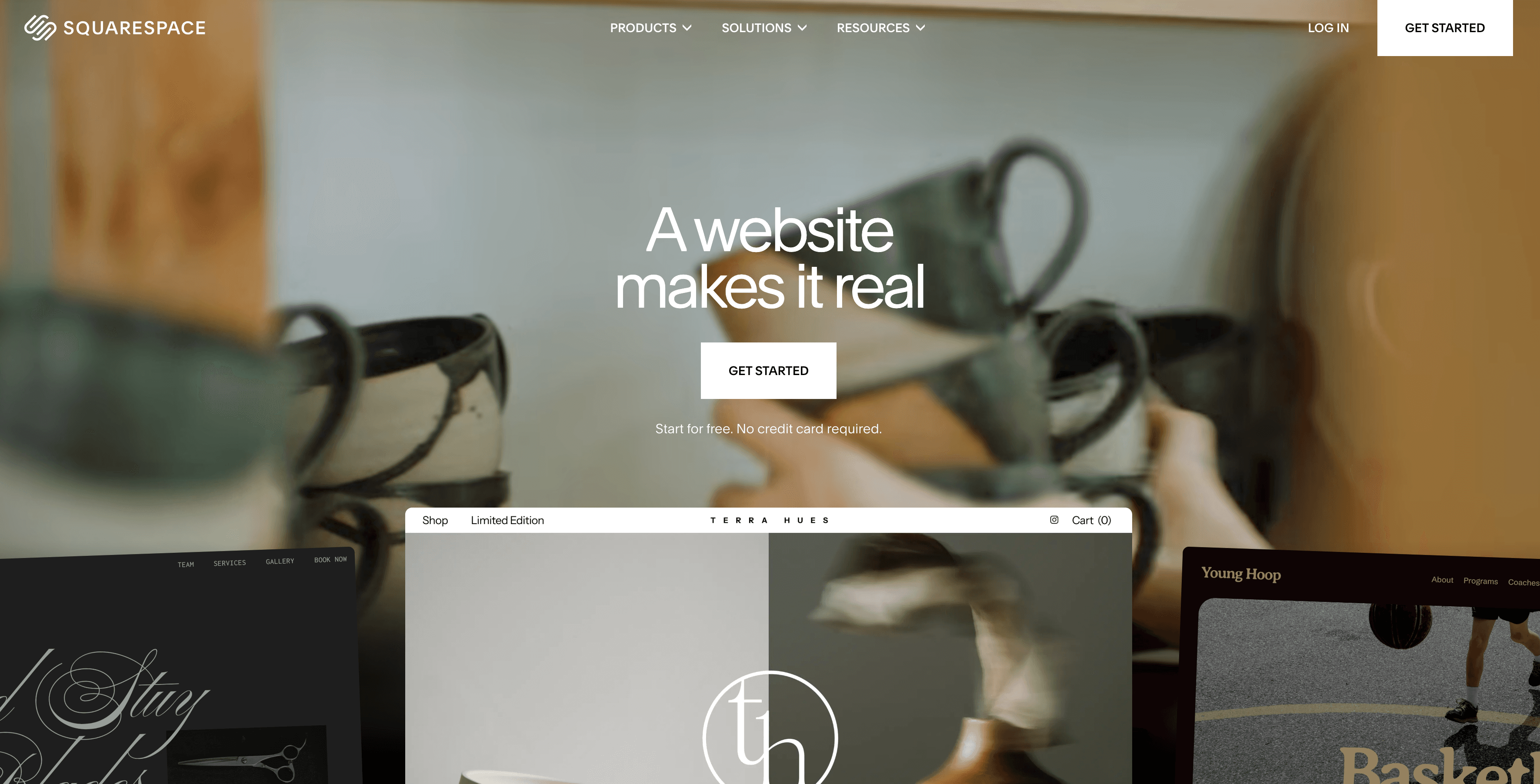
Squarespace is the default for coaches who want a multi-page website with a blog, scheduling integration, and a designed feel out of the box. The tradeoff is time. A solid Squarespace site for a new coach usually takes two to four weekends to launch and locks the coach into an annual plan starting around $16 a month. For coaches who want depth from day one and have the design patience, it is a fine choice. For coaches who need to be live this week, it is the wrong tool.
Carrd
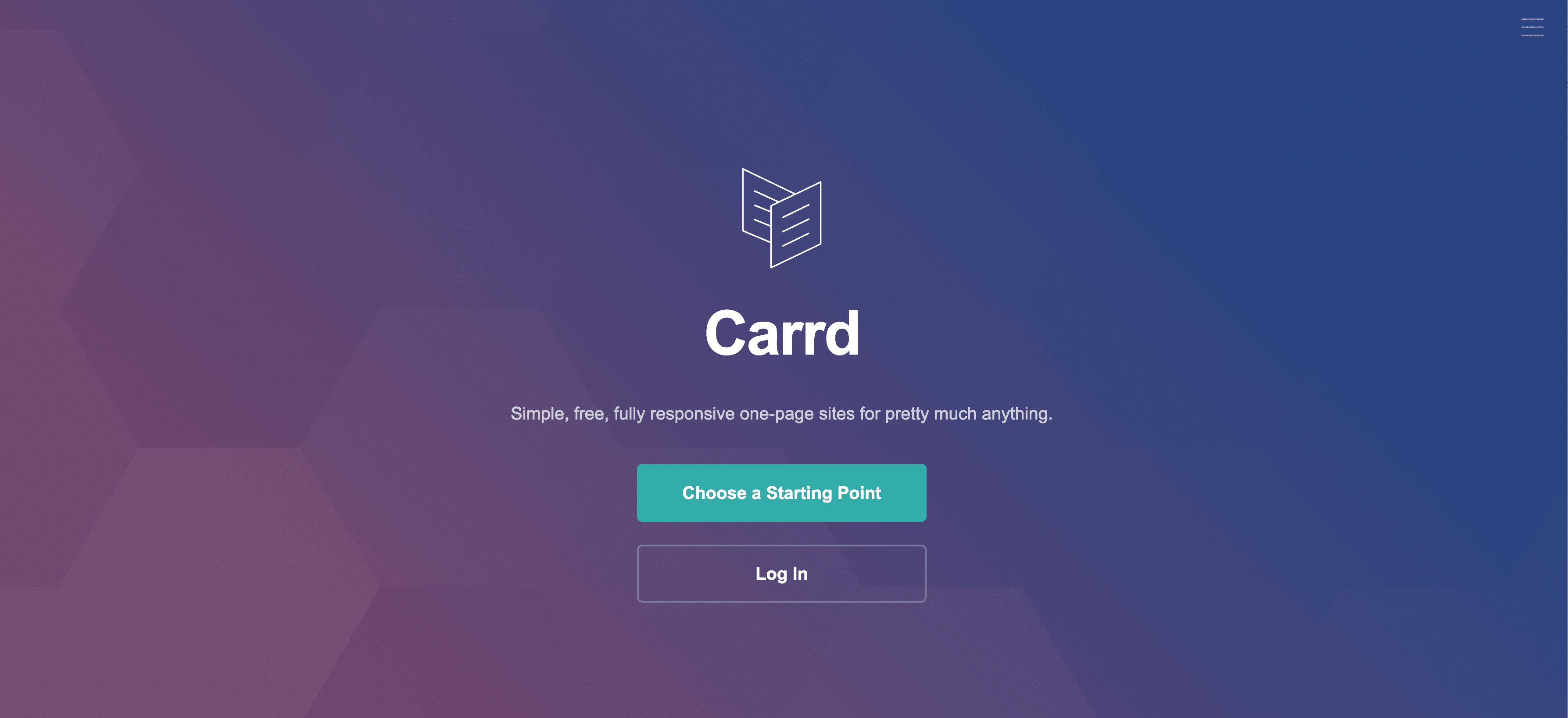
Carrd is the budget option. At $9 to $49 a year, it produces a one-page site fast, but the canvas is blank and there is no AI copy assistance. Coaches comfortable writing their own copy and designing within Carrd's constraints can ship a decent page over a weekend. Coaches who want a niche-aware template, AI copy, or analytics will outgrow Carrd quickly.
A simple comparison for the three most common starting platforms:
| Tool | Best For | Starting Price | Setup Time | Free Tier |
|---|---|---|---|---|
| NiftySite | Solo coaches who want a credible page fast | Free, Pro $15/mo | 10 minutes | Yes, forever |
| Squarespace | Coaches building a multi-page site with blog | From about $16/mo annual | 2 to 4 weekends | Trial only |
| Carrd | Coaches who want a cheap single-page site | From $9/year | A weekend | Yes, limited |
The coaches landing page covers the specific template details, intake questions, and what the published page looks like for a coaching practice.
Step 5: Land the First Paid Client
The first paid client is the hardest. Every client after the first is easier, because the first client is the proof that the offer is real and the practice exists. Most new coaches stall at exactly this step, partly out of pricing fear, partly out of trying to skip to scale before having anything to scale.
The fastest path to a first paid client almost always runs through warm contacts. Not "everyone in the network," but a careful list of fifteen to thirty people who already know the coach's work in some way: former colleagues, former managers, classmates from coach training, people from previous industries who have seen the coach solve relevant problems. The outreach is not a pitch. It is a clear description of the new practice, the named niche, the offer and price, and a direct ask: "If you know someone who fits this, I would love an introduction."
A few principles that consistently work for the first ten clients:
- Be specific about the niche in every conversation. Vague descriptions get vague referrals.
- Always name the price. Free discovery calls that hide the price waste time on both sides.
- Run discovery calls like sales calls, not free coaching. Twenty to thirty minutes, structured. Diagnose, propose, close or pass.
- Ask for the decision on the call. "Would you like to start the program?" is a fair question after a real diagnosis.
- Follow up once, clearly. Most signed clients say yes on the second touch, not the first.
Cold acquisition through content (LinkedIn, podcasts, newsletters) works, but it works on a much slower timeline. It is the right long-term investment. It is the wrong place to source the first three clients. The first three clients come from people who already trust the coach, paired with a clear ask.
Step 6: Deliver in a Way That Protects the Practice
The transition from "I have a few clients" to "I have a real practice" is mostly about systems. Without systems, every new client adds an hour of admin per week. With systems, the next ten clients are mostly automated outside the sessions themselves.
The basics that almost every solo coaching practice needs:
- Scheduling. Cal.com or Calendly removes booking back-and-forth and is free or nearly free at solo volume.
- A simple CRM. Notion, Airtable, or a niche tool like Paperbell. One place to see every client, session, payment, and next step.
- A standard onboarding flow. Welcome email, signed agreement, first invoice, first session booked, all triggered the moment a client says yes.
- A payment processor. Stripe is the default. For coaches selling internationally, Wise or Dodo Payments handle multicurrency cleanly.
- A note-taking system. Session notes in the same place as the CRM, accessible from one screen during sessions.
The trap to avoid is buying a $200-a-month all-in-one coaching platform before there are five paying clients to justify it. A scheduling link, a Notion database, Stripe, and the coaching website at NiftySite cover the first year for most coaches at well under $50 a month total.
Step 7: Keep the Pipeline From Drying Up
The thing nobody warns first-year coaches about: the pipeline collapses about four months in. The first round of warm clients signs, sessions begin, the calendar feels full, and outreach quietly stops. Three months later, when those packages end, the pipeline is empty.
Pipeline work is a weekly habit, not a quarterly panic. A simple rhythm that works for most new coaches:
- Two hours of warm outreach. New introductions, follow-ups with people who said "later," nudges to past clients.
- One piece of public-facing content. A LinkedIn post, a newsletter, a podcast appearance.
- One marketing experiment. A new partnership, a guest workshop, a referral incentive.
- A weekly pipeline review. Twenty minutes every Friday on every active conversation and follow-up due.
Over six months, this rhythm builds a pipeline that does not depend on luck. That shift is the difference between a coaching business that survives year one and one that quietly disappears.
Common Mistakes New Coaches Make
A few patterns show up in almost every stalled coaching practice:
- Niching too late. Every week without a clear niche is a week of slower marketing and weaker referrals.
- Pricing too low. $75 to $150 per session attracts low-commitment clients and shortens the coach's runway.
- Skipping the website. Sending discovery call leads to an Instagram bio or a Linktree page. The conversion gap versus a real one-page site is measurable and large.
- Trying to look bigger than the practice is. Fake team pages and stock photography signal inexperience faster than honesty does.
- Stopping outreach as soon as the calendar fills. The cause of every dry month four months later.
- Overinvesting in tools before the offer is real. A $1,500-a-year all-in-one platform does not fix a vague niche.
Most of these mistakes are reversible, but they cost months. Avoiding them up front is mostly a matter of accepting that a coaching business needs the same disciplined start that any other business needs.
Frequently Asked Questions
How long does it take to start a coaching business?
A solo coaching practice can be ready to take paying clients in two to four weeks of focused work. That covers niche, offer, legal basics, and a published one-page website. Most coaches stretch this to three or four months because they get stuck on tools or branding. The mechanical work is short; the decisions are what take the time.
Do coaches need a certification to start a coaching business?
No, certification is not legally required to call oneself a coach in most jurisdictions. ICF, NBHWC, and similar bodies offer credentials that some corporate buyers and health niches prefer. A new coach with strong positioning and a credible online presence can start without a credential and add one in year one or two if the buyer base demands it.
How much money is needed to start a coaching business?
Less than most people expect. Fixed costs for a solo practice run roughly: LLC formation $50 to $200, business bank account free, liability insurance $300 to $600 a year, scheduling and CRM tools under $30 a month, a coaching website like the website builder for coaches at NiftySite from $0 to $15 a month, and processor fees around 3%. Total first-year fixed costs usually land under $1,500.
What is the best website builder for a new coaching business?
For most new coaches, the best fit is a niche-aware builder that produces a professional one-page site quickly, like NiftySite. Coaches who want a multi-page site with a blog and have weekends to spare can choose Squarespace. Coaches comfortable with a blank canvas and writing their own copy can use Carrd. The wrong choice for almost every coach is putting it off entirely, or relying on a Linktree-style page, which signals "not a real practice" to anyone evaluating.
How much should a new coach charge for a coaching package?
In most niches, a sustainable solo coaching package lands between $2,000 and $10,000 for a three to six month engagement. Hourly rates of $75 to $150 are common for new coaches but make the math hard. Packaged offers with named outcomes consistently outperform hourly rates on both revenue and client commitment.
How do new coaches find their first paying client?
Almost always through warm contacts, not paid ads. A short list of fifteen to thirty people who already know the coach's work, paired with a clear description of the practice and a direct ask for referrals, generates the first three clients faster than anything else. Cold content builds a long-term pipeline but rarely produces the first paid client in the first ninety days.
Can a coaching business be started part-time alongside a full-time job?
Yes, and many successful coaches do exactly this for six to twelve months. Evenings and weekends are enough for two to four clients while building a pipeline. The risk is letting the side practice stay part-time forever. A clear revenue or client-count trigger for the full-time move keeps the transition honest.
Do coaches need an LLC to start coaching?
No, but it is almost always worth forming one. A single-member LLC separates personal and business liability, looks more professional to corporate buyers, and is cheap to form. Sole proprietorship is legal and simpler, but the modest cost of an LLC pays for itself quickly in credibility and protection.
What is the difference between life coaching, business coaching, and other niches?
The label matters less than the niche under it. "Life coach," "business coach," and "executive coach" are broad categories. The defensible practice sits one or two levels deeper: leadership coaching for first-time engineering managers, career coaching for women returning from parental leave, business coaching for solo agency owners past $500,000 in revenue. Specificity is what gets referred, hired, and remembered.
What income can a new coaching business realistically expect in year one?
A realistic range for a focused solo coach with a clear niche and steady pipeline work is $20,000 to $60,000 in year one, scaling to $80,000 to $150,000 by year two if pipeline and referrals continue. Coaches who niche late, price low, or skip pipeline work tend to plateau at $10,000 to $20,000.
How can a coach get clients online without a big audience?
Direct outreach to warm contacts and partnership conversations with adjacent professionals (therapists, fitness coaches, consultants in the same niche) generate clients without a large audience. Public content compounds over twelve to twenty-four months and matters most for the second year, not the first. A clear coaching niche, a published online coaching business website, and a referrable one-line introduction outperform follower counts in year one.
What should be on a coaching website at the start?
Five elements: a one-sentence description of who the coach helps and what outcome, a credible bio with a photo, a named offer with the price or a clear starting price, a way to book a discovery call, and one or two specific testimonials. Anything else is optional. A one-page site that says exactly those five things in ten seconds outperforms a multi-page site with vague language.
Final Thoughts
Starting a coaching business in 2026 is not complicated, but it is unforgiving of vagueness. The coaches who build sustainable practices in the first year share a small set of habits: they pick a defensible niche, they sell a named offer at a price that supports the business, they handle the basic legal and financial setup quickly instead of avoiding it, and they ship a real online presence before they feel ready.
The piece most coaches put off the longest is the website, because the available tools feel either too thin or too heavy. That is a solvable problem. If the plan is to learn how to start a coaching business and have a credible page live by the end of the week, NiftySite is free to start, with a Pro upgrade at $15 a month and no annual lock-in. The first page can be live in about ten minutes, and the practice can grow from there at its own pace.
The work is real, but it is finite. A coaching business does not need to be perfect to start. It needs to be specific, paid, and visible. The rest is iteration.
Last updated: May 2026. NiftySite is the website builder for solo coaches, consultants, and therapists who need a credible online presence in 10 minutes.

Get your coaching website live in 10 minutes.
NiftySite builds a professional one-page coaching site from a short intake. AI writes the headline, bio, and CTA. Free forever, Pro is $15 a month with no annual lock-in.
Start your coaching siteFree forever plan. No credit card. Pro upgrade is monthly, cancel anytime.